Buying a mobility scooter can make everyday journeys easier and help you maintain your independence, but choosing the right one involves more than simply comparing prices, speeds and advertised ranges.
The best choice will depend on how and where you plan to use your scooter, the distances you expect to travel, where it will be stored and whether you need to transport it by car. Comfort and ease of use are equally important, which is why trying different options before buying can be helpful.
If you’re considering buying a mobility scooter in Hertfordshire, this guide covers some of the most important things to think about before making your decision.
Summary
Before buying a mobility scooter:
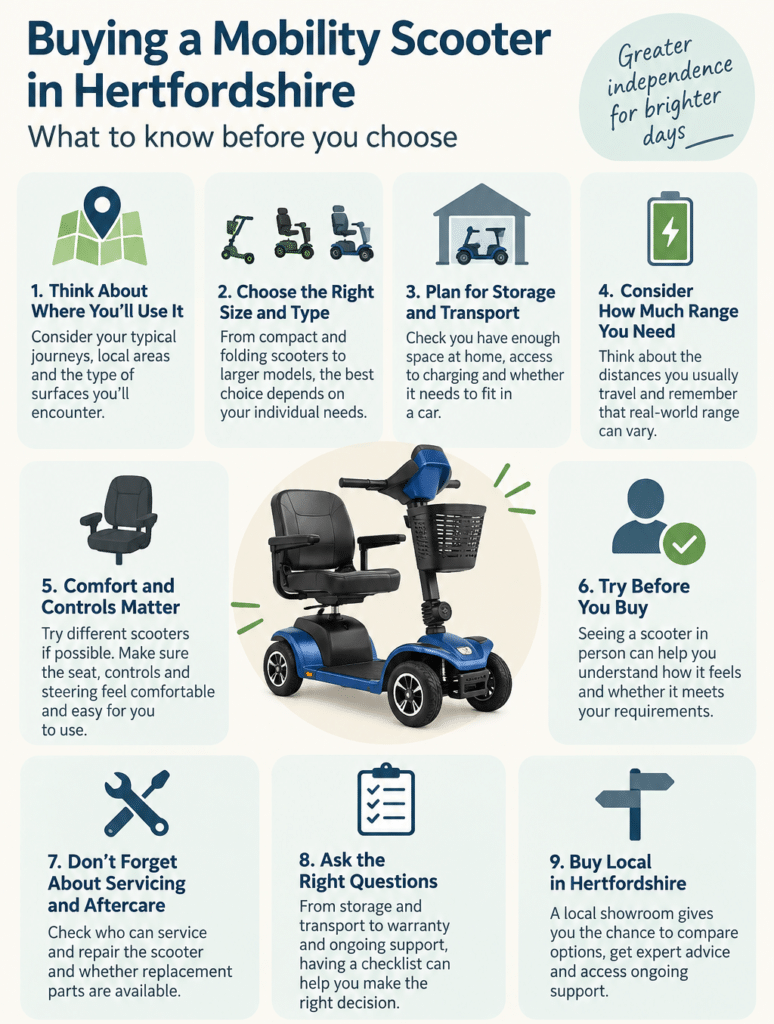
- Think about where you will use it and the distances you regularly travel.
- Consider storage, charging and whether the scooter needs to fit into a car.
- Look beyond specifications and make sure the scooter is comfortable and easy for you to operate.
- Consider the servicing, repairs and aftercare available once you have bought it.
- Where possible, try different mobility scooters in person before deciding which is most suitable for your individual needs.
What Should You Consider Before Buying a Mobility Scooter?
There isn’t one type of mobility scooter that will be suitable for everyone.
Someone who mainly wants a scooter for short trips to local shops may have very different requirements from somebody planning longer journeys or regularly transporting their scooter in a car.
Before comparing individual models, it can therefore help to think about your typical day.
Where do you expect to travel? How far will you usually go? What surfaces are you likely to encounter? Will you need to transport the scooter? Where will it be kept when you’re at home?
Answering these questions first can make it much easier to narrow down the options available.
Where Will You Use Your Mobility Scooter?
How you intend to use your mobility scooter should be one of the biggest considerations when choosing one.
For shorter journeys, such as visiting nearby shops or travelling around a town centre, a smaller scooter may provide everything you need. If you’re planning longer journeys or regularly travelling over more varied surfaces, comfort, stability and range may become more important.
Think about the places you are likely to visit regularly rather than focusing solely on the maximum capabilities of a scooter.
For example, somebody using their scooter primarily for local journeys around Hertford may have different requirements from someone regularly travelling longer distances across Hertfordshire.
It is also worth considering the surfaces you are likely to encounter. Smooth pavements, dropped kerbs, slopes and rougher ground can all affect how a scooter feels to use.
What Size and Type of Mobility Scooter Do You Need?
Mobility scooters are available in a wide range of sizes and designs, with different options suited to different types of journeys.
Compact and Folding Mobility Scooters
Compact and folding scooters can be useful for people who need something easier to store or transport.
Some models are designed to fold, while others can be dismantled into smaller sections for transportation. This can make them particularly useful if you expect to regularly take your mobility scooter in a car.
Their smaller size can also make storage easier where space at home is limited.
Pavement Mobility Scooters
Pavement scooters can provide a balance between manoeuvrability, comfort and range for everyday outdoor journeys.
If you plan to use your scooter for trips to the shops, appointments or other journeys within your local area, this type of scooter may be worth considering.
Larger Mobility Scooters
Larger scooters can provide additional comfort, stability and range for people making longer journeys.
However, their additional size also means storage, access and transportation need to be considered carefully before purchasing.
The largest or most powerful scooter isn’t automatically the best choice. The aim is to find equipment suited to the journeys you actually expect to make.
Think About Storage and Transport Before You Buy
It’s easy to concentrate on what a mobility scooter is like to drive and overlook what happens when you get home.
Before buying, consider where the scooter will be stored and charged.
You may want to check:
- whether there is enough space to store the scooter safely
- the width of any doorways or entrances it needs to pass through
- access to a suitable charging point
- whether there are steps or other obstacles between the scooter and your home
- whether the scooter needs to fit inside a particular vehicle
If you intend to regularly transport your scooter by car, check its dimensions and weight as well as how it folds or dismantles.
Individual components may still be relatively heavy even when a scooter can be taken apart, so it’s worth considering how practical the process will be for you or whoever will be helping to transport it.
How Much Mobility Scooter Range Do You Actually Need?
Range is often one of the first specifications people compare when looking at mobility scooters for sale.
However, the largest advertised range isn’t necessarily something everyone needs.
Start by thinking about the journeys you actually expect to make and how frequently you will be able to charge the scooter.
It is also important to remember that quoted ranges are generally based on particular test conditions. Real-world performance can vary depending on factors such as terrain, gradients, the weight being carried, temperature and battery condition.
Having sufficient range for your regular journeys is important, but it should be considered alongside comfort, size, storage and the other features you need.
Comfort and Controls Matter More Than Specifications Alone
A mobility scooter can look suitable on paper but feel very different once you sit on it and start using the controls.
Comfort is particularly important if you expect to spend longer periods of time on your scooter.
Consider the seating position, available legroom and how easy it is to get on and off. You should also consider whether the steering position and controls are comfortable for you to operate.
Different scooters can feel noticeably different to drive, even when their specifications appear similar.
This is one reason why seeing and trying mobility equipment in person can be valuable before making a purchase., electrical systems and mechanical components.
You can also view our mobility supplies for accessories and other equipment that may support everyday scooter use.
Can You Try a Mobility Scooter Before Buying?
Where possible, trying a mobility scooter before buying can help you understand whether it feels right for you.
Photographs, specifications and online descriptions can tell you a lot about a particular model, but they can’t tell you exactly how comfortable the seat will feel or whether you find the controls easy to operate.
Trying a scooter gives you an opportunity to consider things such as:
- how comfortable the seating position feels
- whether you have enough legroom
- how easily you can get on and off
- whether the controls are comfortable to operate
- how the steering feels
- whether the scooter’s physical size suits you and your requirements
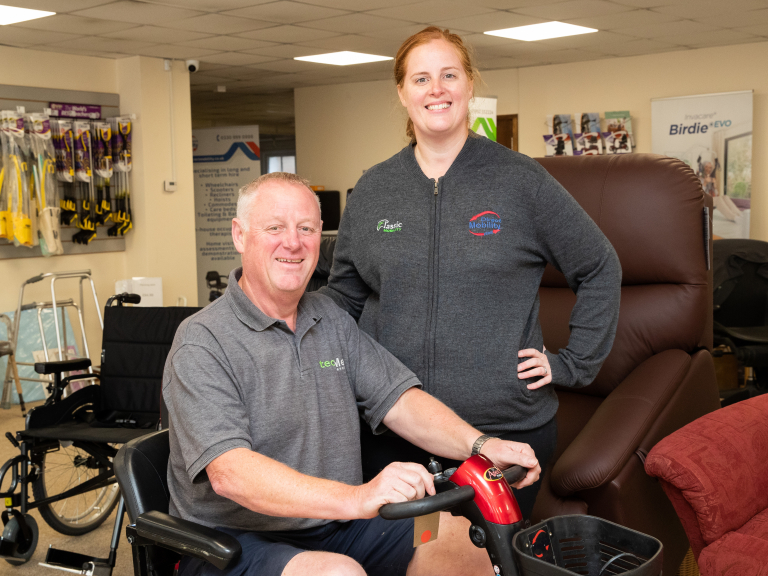
At Classic Mobility’s Hertford showroom, customers can see and try a range of mobility equipment in person and speak to the team about their individual requirements before deciding what may be suitable.
Don’t Forget About Servicing and Aftercare
When comparing mobility scooter retailers, it is worth considering what happens after you’ve made your purchase.
Like other mechanical and electrical equipment, mobility scooters require ongoing care and maintenance. Components can wear over time, batteries may eventually need replacing and faults can occasionally develop.
Before buying, consider asking:
Who can service the scooter?
What happens if it needs repairing?
Can replacement parts be sourced?
Is there somewhere local you can take it if a problem develops?
Having access to ongoing support can be particularly valuable if you rely on your scooter for everyday journeys.
Classic Mobility has experienced mobility engineers providing servicing and repairs for mobility scooters and other mobility equipment. Routine servicing can also help identify signs of wear before they develop into more significant problems.
Want to know more about keeping your scooter in good condition? Read our guide on how often a mobility scooter should be serviced.
Questions to Ask Before Buying a Mobility Scooter
Before making your final decision, it can help to run through a simple checklist:
- Where will I use the scooter most often?
- How far do I normally need to travel?
- What type of surfaces will I encounter?
- Where will I store and charge it?
- Will I need to transport it by car?
- Is the scooter comfortable and easy for me to control?
- Can I try it before buying?
- What servicing, repair and aftercare support is available?
If you’re unsure about any of these points, speaking to an experienced mobility specialist can help you compare the options available.
Buying a Mobility Scooter in Hertfordshire
If you’re looking at mobility scooters for sale in Hertfordshire, visiting a physical mobility showroom can give you the opportunity to compare different options before making a decision.
Rather than choosing solely from photographs and specifications, you can see the size of different scooters, sit on them, try the controls and discuss how you expect to use your equipment.
Classic Mobility is a family-run mobility specialist based in Hertford and has been helping customers with mobility equipment since 1995.
At our Hertford showroom, you can view and try mobility equipment and speak to our team about your requirements. We also provide ongoing servicing and repair support, giving customers somewhere local to turn if their equipment needs attention in the future.
If you’re considering buying a mobility scooter and aren’t sure where to start, you’re welcome to visit the showroom or contact our team for advice.
Frequently Asked Questions
Can I try a mobility scooter before buying one?
Yes. Many physical mobility showrooms allow customers to see and try different scooters before purchasing. Trying a scooter can help you assess comfort, controls, steering, size and how easy it is for you to get on and off. Classic Mobility’s Hertford showroom allows customers to see and try mobility equipment in person.
How do I know what size mobility scooter I need?
The appropriate size depends on factors including where you plan to use the scooter, the distances you expect to travel, available storage space and whether you need to transport it. Your own comfort and ability to operate the scooter should also be considered.
How far can a mobility scooter travel on one charge?
This varies considerably between models. Manufacturers provide estimated ranges, but actual range can be affected by factors including terrain, gradients, load, temperature and battery condition. When comparing scooters, consider the distances you regularly expect to travel rather than relying on advertised range alone.
Where should I store a mobility scooter?
A mobility scooter should generally be kept somewhere secure and protected from unsuitable weather conditions, with access to an appropriate charging point. Before purchasing, check the manufacturer’s storage and charging guidance for the particular model you are considering.
Where can I buy a mobility scooter in Hertfordshire?
Classic Mobility has a mobility showroom in Hertford where customers can view and try mobility scooters and other mobility equipment. Visiting a showroom also gives you the opportunity to discuss your requirements and ask questions before purchasing.


